You can't really know where the Bills are going until you know where they've been.
Honestly? Things have been great. The drought is in the rearview. The current regime nurtured an NFL MVP and ensured the team would remain in Buffalo. The new stadium opens this summer. Tracy McGrady and Vince Carter own a slice of the team. That's sick as hell.
The past two seasons, however, have been simmering toward a boiling point that finally blew its lid in Jacksonville.
Buffalo entered the game with five wide receivers. They left it with only three. How could the season possibly come down to this? To not having enough players to catch the ball from the reigning MVP — in the fucken Divisional Round?
What happened to the Bills receivers this season?
Entering the playoff game against the Broncos:
Khalil Shakir was the only WR to play in every "meaningful" game this season (i.e. he was rested in Week 18 with Bills' playoff positioning set).
Curtis Samuel returned from injured reserve just four days before the Divisional Round after not practicing or playing since Week 11. He opened the season as a healthy scratch and didn't play until Week 4. He has seven receptions this season.
Brandin Cooks joined the Bills around Thanksgiving after he was granted his release from the Saints. He has eight receptions since joining the team.
Mecole Hardman was signed to the practice squad on November 12 and elevated to the active roster on November 15. He was waived on December 27 before re-joining the practice squad on December 30. He has played in two games this season. He has yet to make a catch but has lost a fumble.
Jaylen Waddle was not acquired at the trade deadline. Five days later on November 9, the Dolphins beat the Bills in Miami and Waddle had 5 receptions for 84 yards and a touchdown.
Gabe Davis had been on the practice squad since opening weekend but didn't play until Week 11. He played the next three games before he was a healthy scratch in Weeks 15 and 16. In the playoffs against the Jags, he had 2 catches for 14 yards and was involved as a blocker before tearing his ACL.
Tyrell Shavers mostly contributed on special teams and as a blocker but popped up for a few splash plays on offense. Unfortunately, his season also ended in Jacksonville. Shavers tore his ACL in the second quarter but somehow returned to finish the game, playing 34 total snaps on offense.
Keon Coleman played 27 snaps on offense against the Jags. They were his most meaningful snaps since Week 15. Coleman was a healthy scratch for multiple games for disciplinary reasons, including repeatedly showing up late for meetings. Since Week 8, in games with Josh Allen, Coleman has 13 catches for 154 yards and 2 TDs but hasn't had more than 3 catches or 50 yards in a game.
Josh Palmer signed a 3-year contract with the Bills on March 10, including $18 million guaranteed. He appeared in 12 games and had 22 receptions for 303 yards and no touchdowns. Palmer was placed on IR with an ankle before the playoffs.
Elijah Moore signed a 1-year deal with the Bills on May 5. He played in nine games and had 9 receptions for 112 yards and no touchdowns. He was waived on November 26, the day before Thanksgiving. On December 2, the Broncos signed him to their practice squad.
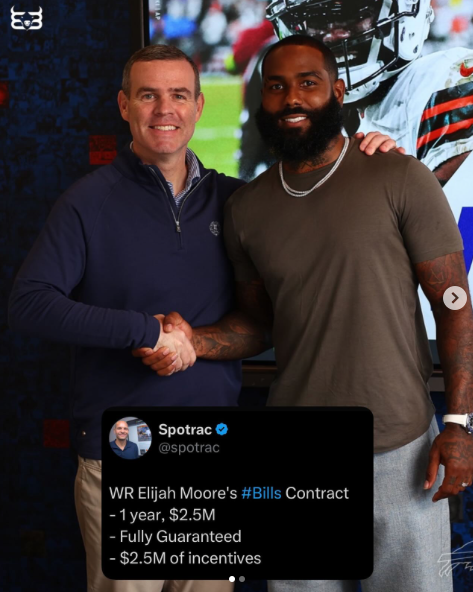
Elijah Moore was signed two weeks after the 2025 NFL Draft. The week before he was signed, Buffalo Bills GM Brandon Beane appeared on local radio WGR550 and took offense to the hosts criticizing the team's wide receivers.
"You guys are bitching that we don't have a receiver. I don't get it. We just scored 30 points in a row for eight straight games.... A year ago? I get you guys asking why we 'didn't have receivers,' but I don't understand it now. You just saw us lead the league in points. When you add [in] all the postseason [games], no one scored more points than the Buffalo Bills — including the Super Bowl champion [Philadelphia Eagles].
You just saw us do it without Stefon Diggs, same group. How is this group not better than [2024's group]? Our job is to score points and win games. Where did we need to get better? Defense. We did that."
"Let's be realistic. Our job is not fantasy football, like to trot out the best receivers. You've got Josh Allen: First thing you've got to do is protect him. You can't have everything. You can't have Pro Bowl wide receivers, and have a Pro Bowl offensive line, and an All-Pro quarterback, and three great running backs. Like, you've got to pick. Sure, I'd love to play fantasy football but there's only one football. There's one ball."
"So I get it, you've got to have a show and you've gotta have something to bitch about. But bitching about wide receivers is one of the dumbest arguments I've heard." — Brandon Beane after the 2025 NFL Draft
Below you'll find several thousand words about fixing the Bills wide receiver problem. If you don't have time for all that, hang tight for the TLDR to get the gist.
TLDR
In a perfect world, the Bills would hash out some trades over steaks at St. Elmo's during Combine weekend:
- Trade their 2026 5th-round pick for Michael Pittman Jr. and sign him to a short-term extension to fix their "big bodied X receiver" problem.
- Trade their 2026 1st-round pick to the Jaguars for Brian Thomas Jr. to fix their "downfield boundary threat" problem.
In the real world, Pittman's contract will be tough to navigate while the Bills try to re-sign their players and backfill the roster with veteran free agents.
Thomas was rumored to be available at the 2025 trade deadline, but he fills a key role on the Jaguars offense and still has two years remaining on a cost-controlled rookie deal (plus a 5th-year option). BTJ has seen boundary shots at roughly double the rate of any wideout currently on the Jags roster.
Makai Lemon is the receiver I'd take in the 1st Round and would be willing to trade multiple draft picks (2026 1st and 2nd, 2027 3rd) to select him.
That might be considered too rich, though, for a prospect deemed more of a "ground-rule double." Brandon Beane has been willing to trade-up for his guy in the past, but more often than not he has tried to "sock a dinger" with his top selection. Receivers like Denzel Boston (a big-bodied target like Keon Coleman) should be available near the end of the 1st round.
Cuts and Restructures: Realistically, the Bills could have anywhere between $25-$40 million in cap space when free agency opens in March. The offensive line will likely take a hit as LG David Edwards ($20 mil) and OC Connor McGovern ($16 mil) are projected to earn $36 million per year on the open market. The Bills will need to backfill those positions with veterans they trust (OG/OC Ryan Bates, OT David Quessenberry) to coach up the next wave in addition to restocking an aged defense ahead of the draft.
Ten Percent: Khalil Shakir, Josh Palmer, and Keon Coleman project to make the 2026 roster with Tyrell Shavers (R-FA) beginning the season on injured reserve.
After cutting Curtis Samuel ($3.5 million dead-cap hit) and re-signing Shavers this offseason, the Bills can open up anywhere from $6-$15 million in additional cap space if they're willing to restructure Shakir (likely; one void year) and Palmer (unlikely; three void years).
Shakir, Palmer, Coleman, and Shavers would account for roughly $25 million of the Bills 2026 cap, leaving around $7 million or so for a few WR additions in the budget (10% of the Bills 2026 salary cap).
So what's the likely fix?
*Give me a second while I let out the longest sigh you've ever heard in your life*
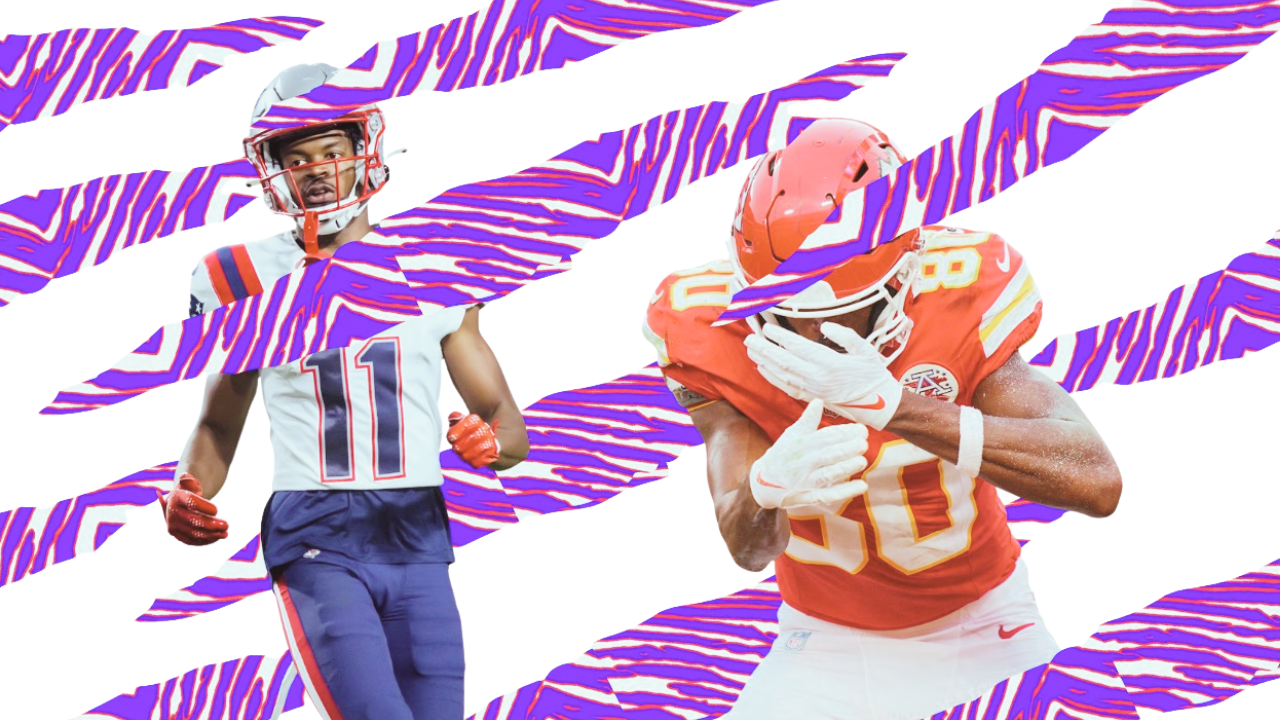
The Fix: Sign Tyquan Thorton in free agency, draft at least one wide receiver on Day 1 or 2 of the draft and invite several UDFAs to rookie minicamp in the spring. Sign Mack Hollins if he's cut by the Patriots.
Bills fans might actually revolt if the front office's only wide receiver move during free agency is signing rotational (yet effective!) deep threat Tyquan Thorton. If that's how things play out, though, the front office should consider banging the drum — loudly and perhaps nonstop — that they will address WR early in the NFL Draft.
In any case, there's one move the Bills can make before free agency opens in March.
Not to be dramatic but seriously: it could have the single biggest impact on the Bills receiving corps for years to come.
1. Bring Back Chad Hall
Posted by Jon Scott of WGRZ-Buffalo on (9/22/21)
"He's one of, if not the best coach I've ever had" —Stefon Diggs on Chad Hall
Chad Hall spent six seasons with the Bills from 2017-22, first as an offensive assistant then as the wide receivers coach. In 2019, John Brown became the first WR coached by Hall to reach 1,000 receiving yards — and Hall's been coaching 1,000-yard receivers ever since.
Stefon Diggs eclipsed 1,000 yards in three straight years (2020-22) and was a 1st Team All-Pro in 2020 (Bills' slot receiver Cole Beasley made the 2nd Team that season).
Following the 2022 campaign, Hall was hired away by Doug Pederson in Jacksonville to be their WRs coach. Calvin Ridley had 1,000 receiving yards in 2023 and was rewarded with a contract from the Titans in free agency.
Following Ridley's departure, Gabe Davis chose to sign with the Jaguars and reunited with his former teacher. The Jags drafted Brian Thomas Jr. who went on to produce the NFL's third most receiving yards (1,282) and scored 10 touchdowns during his rookie season.
Seven Season Streak
| Team | Season | Top WR | Recs | Yards |
|---|---|---|---|---|
| Bills | 2019 | J. Brown | 72 | 1,060 |
| Bills | 2020 | S. Diggs | 127 | 1,535 |
| Bills | 2021 | S. Diggs | 102 | 1,225 |
| Bills | 2022 | S. Diggs | 108 | 1,429 |
| Jags | 2023 | C. Ridley | 76 | 1,016 |
| Jags | 2024 | B. Thomas | 87 | 1,282 |
| Giants | 2025* | W. Robinson | 92 | 1,014 |
*Was the NYG Asst. QBs Coach
The Jags moved on from Pederson after the 2024 season. Hall landed with the G-Men where he reunited with Brian Daboll and was promoted to assistant quarterbacks coach.
Dabes was fired after a 2-8 start. The Giants promoted OC Mike Kafka to interim head coach and they finished the year with a 4-13 record. All the while, Hall was tasked with managing a room that at one point included Tommy DeVito, Russell Wilson, Jameis Winston, and rookie Jaxson Dart.
| Week | Opponent | QB | Total TDs | Total Yds |
|---|---|---|---|---|
| 18 | DAL | J. Dart | 2 | 262 |
| 17 | @LVR | J. Dart | 2 | 255 |
| 15 | WAS | J. Dart | 2 | 309 |
| 12 | @DET | Jameis | 3 (1 rec.) | 412 |
| 7 | @DEN | J. Dart | 4 | 294 |
| 6 | PHI | J. Dart | 2 | 253 |
| 2 | @DAL | R. Wilson | 3 | 473 |
Almost certainly, Hall will be looking for a new job this offseason as the Giants remake their staff.
The Bills should do everything in their power to get Hall back in their building and give him a well-earned promotion.
Promote Him to Passing Game Coordinator
Buffalo didn't have a passing game coordinator on staff during the 2025-26 season. The Bills have been patient with their coaching decisions, opting for continuity rather than churn, so adding Hall rather than subtracting from the current staff would make a lot of sense.
Promoting Hall to passing game coordinator would allow him significant input on the passing game moving forward, much like the Bills have done with longtime offensive line coach Aaron Kromer and their running game.
"Kromer doesn’t hold the title of run game coordinator, but that’s what he is in addition to guiding and drilling offensive linemen. With help from tight ends coach Rob Boras, Kromer is responsible for devising Buffalo’s ground attack each week, identifying which rushing plays will work best, and suggesting in-game what offensive coordinator Joe Brady should call when it’s time to run." —Excerpted from Tim Graham for The Athletic
2. Extend Dawson Knox
Knox on Allen, originally posted by the Bills (1/21/22)
"I pray that I get to spend the rest of my career playing with him. There's not a single person on this team that wouldn't say the same. Every game he's got blood, cuts and bruises literally putting his body on the line every single play for all of us. He really is a warrior. A modern day gladiator." —Dawson Knox on Josh Allen in January 2024
The Bills could — and arguably should — make it so Josh Allen and Dawson Knox's contracts are tied together for as long as they're playing in Buffalo. Allow me to explain.
Knox Is Entering a Contract Season
| Year | Age | Cap Hit | Dead Cap | (+/-) If Cut |
|---|---|---|---|---|
| 2024 | 28 | $7.7 Mil | $24.5 Mil | - |
| 2025 | 29 | $14.6 Mil | $21.5 Mil | - |
| 2026 | 30 | $17.1 Mil | $7.4 Mil | +$9.7 Mil |
| 2027 | 31 | $1.2 Mil | $2.4 Mil | $0 (Void) |
| 2028 | 32 | $1.2 Mil | - | $0 (Void) |
The Bills could save roughly $9.7 million this offseason if they were to move on from Knox before March 16 but I don't believe they'll do that.
Instead, they can sign Knox to an extension to lower his 2026 cap hit. Right now, Knox has the fifth-highest cap hit on the team and it's $5 million more than Josh Palmer, a 2025 signee whose contract offers little-to-no flexibility as far as freeing up some much-needed cap space.
Using Spotrac's database as my guide, I've drawn up a dummy contract that could save the Bills $7 million against the cap and keep Knox in Buffalo longterm.
| Year | Age | Cap Hit | Dead Cap | (+/-) If Cut |
|---|---|---|---|---|
| 2026 | 30 | $10.0 Mil | $30.6 Mil | -$20.6 Mil |
| 2027 | 31 | $11.0 Mil | $20.6 Mil | -$9.6 Mil |
| 2028 | 32 | $12.4 Mil | $10.2 Mil | +$2.2 Mil |
| 2029 | 33 | $4.0 Mil | $4.0 Mil | $0 (Void) |
| 2030 | 34 | - | - | $0 (Void) |
There's $12 million remaining on Knox's current deal, and this extension would give him a million-dollar raise in 2026 and more than $10 million in additional guaranteed money to stick around Buffalo on Allen's timeline.
Allen's contract is likely to be restructured following the 2028 season when his cap hit balloons to more than $86 million (against a dead-cap hit of just $11 million), meaning Allen and Knox's contracts could be revisited in early 2029.
Knox has already agreed to a contract restructure once before, during the 2024 offseason, to secure more guaranteed money upfront and less on the backend — essentially agreeing to a pay cut.
However, it should be noted that Knox had player-friendly incentives built into his contract. While most players have non-cumulative benchmarks they need to hit to reach incentives, the Bills allowed Knox multiple seasons to secure his bonuses.

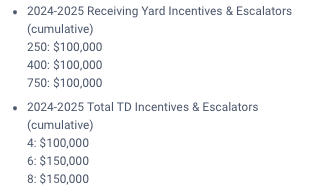
Player-friendly incentive structure: 2024-25 (cumulative) benchmarks
For a potential extension, I focused on securing as much guaranteed money as possible while more or less keeping his annual salary in line with what he's made in recent seasons.
Here's a more detailed breakdown of what a Knox extension could look like.
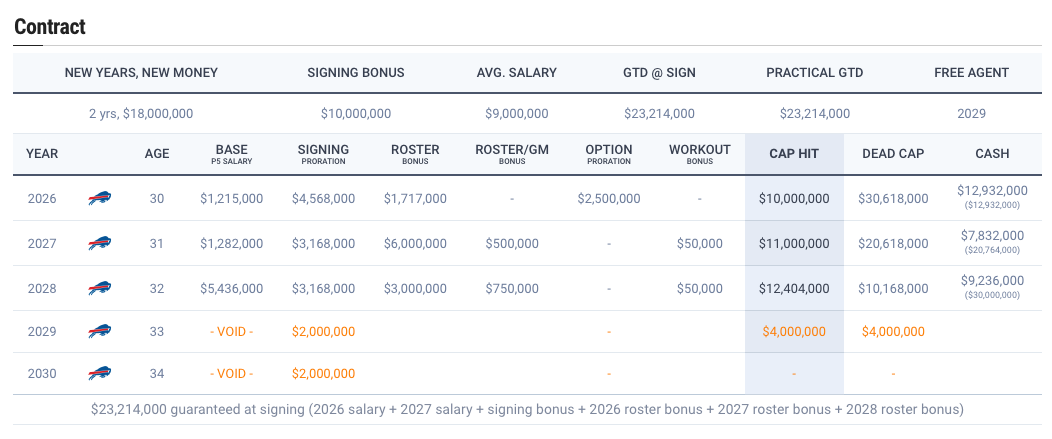
I used Tyler Higbee's contract as one guide post, based on his age when he signed and the Rams guaranteeing almost all of the money, and John Bates's contract as another guide post, as the Commanders blocking TE hasn't been as productive in the passing game but is a good blocker and essential to what Washington wants to be on offense.
Higbee was making $8.5 million on average and will now be a free agent in what would be his age 33 season. His projected market value is about half that, dipping to $4.8 million based on Spotrac's projections.
2026 Free Agents
| Tight End | Age | Current Salary | Market Value |
|---|---|---|---|
| K. Pitts | 25.2 | $8.2 Mil | $14.6 Mil |
| C. Okonkwo | 26.2 | $1.0 Mil | $12.3 Mil |
| T. Kelce | 36.2 | $17.1 Mil | $11.0 Mil |
| D. Njoku | 29.4 | $13.7 Mil | $10.4 Mil |
| I. Likely | 25.7 | $1.0 Mil | $9.1 Mil |
| C. Otton | 26.7 | $1.1 Mil | $7.7 Mil |
| T. Higbee | 33.0 | $8.5 Mil | $4.8 Mil |
| D. Waller | 33.2 | $2.0 Mil | $3.5 Mil |
| N. Fant | 28.1 | $2.8 Mil | $2.9 Mil |
| F. Moreau | 28.6 | $4.1 Mil | $2.7 Mil |
| Z. Ertz | 35.1 | $6.3 Mil | $2.4 Mil |
| Taysom Fucken Hill | 35.3 | $10.0 Mil | $1.2 Mil |
Tacking on two new years to Knox's contract with a chance to restructure and extend him again in 2029, during his age 33 season, would make a lot of sense for all parties involved.
Knox recently set the Bills' franchise record for career receiving touchdowns by a tight end and would be in line to break the receptions and yardage records in the coming seasons.
If the Bills can get Allen and Knox in a room together and lay out this longterm view — about keeping them together in Buffalo for their entire careers — I think it would help stabilize the team from a locker room and cap standpoint.
And the Bills shouldn't have any trouble getting them in a room together.
Best Friends Forever
Video originally posted by the Bills on September 11, 2021
What was Josh Allen doing when news of his first big contract extension broke?
I was actually playing Catan with some of the boys in the tight ends room, and Dawson goes, “Oh my gosh, Josh. Congrats!”
Settlers of Catan remains a big part of Allen and Knox's off-the-field relationship, so big in fact that ESPN's Alaina Getzenberg did a whole-ass story about it in September 2024.
 Alaina Getzenberg
Allen has repeatedly said how much he trusts Knox, both on and off the field, and it's clear he's his best friend on the team.
But perhaps the biggest feather in Knox's cap that everyone should be on board with — even the fans who are worried about his drops; the accountants who are worried about the cap — is that Knox is exactly the right type of player that Josh Allen's Bills need to be successful.
Allen is the type of quarterback who, I mean — all he really wants to do is go out there and play ball with his friends. It's an archetype Seth Wickersham explores in his book American Kings: A Biography of the Quarterback, and it brings to mind how Allen wants to be well-liked, to not only be great but to make sure everyone knows how great his friends are, too.
It's why things didn't work out with Stefon Diggs whose best friend is the ball itself. Allen did everything in his power to get the ball to Diggs as often as possible but the Bills came up short in the playoffs. When Diggs didn't get the ball as often as possible, he made sure to make his frustrations known on social media.
Knox isn't the focal point of the offense, of course, but he's also not demanding the ball. He's just another guy who's happy to be out there with his friends.
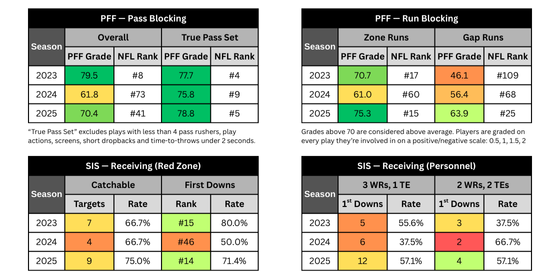
When the Bills announced they were switching to more of an "everybody eats" passing offense after trading away Diggs during the 2024 offseason, it was clear the front office knew the best thing for Allen and the Bills would be an offense centered around their QB distributing the ball to the open man — not an offense where the QB is stressed about whether or not Diggs or any other player was getting the ball enough.
Trading away Diggs was the front office's way of saving Allen from himself. It led to him winning the 2024 NFL MVP Award.
With all that in mind as the Bills face mounting criticism about their wide receivers heading into the 2026 offseason, I believe there's one trade candidate that stands out above the rest as the right type of player for this Buffalo offense.
3a. Trade for Michael Pittman
Video originally posted by James Boyd (The Athletic)
"I've been here for six years, it's been a good six. You know, I'm hoping it's not but if this is my last then I've really had a great time playing here." —Michael Pittman following the Colts' Week 18 defeat.
The Colts began the 2025 season with an 8-2 record behind one of the more prolific offenses in NFL history. Michael Pittman Jr. was the clear WR1 and near the top of the league in receiving touchdowns, first downs, total receptions, and catch rate heading into the Colts BYE week.
They didn't win another game. In Week 14, Daniel Jones suffered a season-ending torn Achilles that led to Philip Rivers coming out of retirement to try and save their season. The Colts finished the year at 8-9 and missed the playoffs for the fifth consecutive season.
From Weeks 12-18, Pittman's role in the Colts passing game shrunk significantly. He dropped to #21 in touchdowns, #23 in first downs, #20 in total receptions, and #19 in catch rate out of 27 high-volume wide receivers across the league.
At the same time, Alec Pierce put together the best stretch of his career. He tied Jaxon Smith-Njigba and Chris Olave with 5 receiving touchdowns and was #14 in yards during the final seven games of the season, averaging 22 yards per reception.
Pittman never complained about his reduced role. There were no reports of any discontent or sideline shots of a player annoyed by his dwindling target rate.
Colts Free Agents and Extension Candidates
The Colts announced they would retain GM Chris Ballard and HC Shane Steichen after the season and together they'll have to make some tough financial decisions about their wide receiver room in 2026 and beyond.
Alec Pierce is a free agent but the Colts are likely to use a projected $28 million WR franchise tag to retain him (in early March) as they negotiate a contract extension (by mid-July).
The Colts could save $24 million in cap space by trading or cutting Michael Pittman before March 16.
2026 Free Agents
| Player | Age | Position | Previous Salary | Market Value |
|---|---|---|---|---|
| The Dimesman | 28.6 | QB | $14.0 Mil | $44.6 Mil |
| Alec Pierce | 25.7 | WR | $1.7 Mil | $20.3 Mil |
| Kwity Paye | 27.1 | EDGE | $3.4 Mil | $17.8 Mil |
| Braden Smith | 29.8 | RT | $17.5 Mil | $13.5 Mil |
| Nick Cross | 24.2 | SAF | $1.3 Mil | $6.1 Mil |
| Samson Ebukam | 30.6 | EDGE | $8.0 Mil | $2.9 Mil |
| Germaine Pratt | 29.6 | LB | $1.5 Mil | $2.9 Mil |
Extension Candidates
| Player | Age | Position | Previous Salary | Market Value |
|---|---|---|---|---|
| Michael Pittman Jr. | 29.2 | WR | $23.3 Mil | $29.1 Mil |
| Quenton Nelson | 30.8 | OG | $20.0 Mil | $23.2 Mil |
| Jonathan Taylor | 27.9 | RB | $14.0 Mil | $15.4 Mil |
| Josh Downs | 25.3 | WR | $1.4 Mil | $14.0 Mil |
While Indy has roughly $53 million in projected cap space heading into the offseason, a considerable portion of that will end up going to the quarterback room.
Spotrac projects Daniel Jones's next contract to come in around $45 million per year, which seems a tad high for a player with his injury history (neck '21, ACL '23, Achilles '25) and streaky production (notably better in contract years).
We've seen Aaron Rodgers and Kirk Cousins struggle for more than a season off of an Achilles before they resembled anything close to their former selves, and even then they weren't able to consistently string together quality starts.
Aside from addressing the league's highest paid position, other Colts free agents are projected to collectively earn $63.5 million in average annual value (AAV) on the open market, or $8 million more than the Colts have to spend.
They could open up some room by extending franchise-legend Quenton Nelson but it seems less likely that the Colts would want to extend a WR going on 30 or a running back going on 28 to free up additional 2026 cap space by "kicking the can down the road" — i.e. pushing guaranteed money into the future that would limit their cap space in exchange for trying to win in 2026 with a new QB or one coming off a torn Achilles.
The Colts chose to stick with Steichen and Ballard, however, and it seems likely that both are thinking about the here and now and not the future of the franchise.
“If we stuck in the alley and we about to get jumped, we all know that Pitt is one of those dudes that we want with us. He’s gonna find a way to get it done.” —Reggie Wayne on Michael Pittman, Colts training camp 2024
Keon Coleman + 5th Rd Pick
Keon Coleman is the type of player Chris Ballard typically falls for in the draft: Big, explosive, young with seemingly limitless upside.
Since the draft, though, Coleman has exhibited the exact type of behavior that Shane Steichen is known to abhor.
Coleman was a healthy scratch for the Bills multiple times during the 2025 season, first for disciplinary reasons (late for meetings) then seemingly performance reasons (an inability to get open downfield). He's committed avoidable penalties (offensive pass interference, illegal touching, not lining up correctly at the snap) throughout his college and pro career.
Ballard (and presumably Steichen) shipped Adonai Mitchell to the Jets at the 2025 trade deadline after Mitchell infamously let go of the ball before scoring a would-be long touchdown, fumbling it out of the endzone for a turnover.
During the 2024 season, Anthony Richardson asked to be removed from the game "because he was tired" and that essentially ended his tenure as Colts quarterback, motivating Steichen and Ballard to pursue Daniel Jones last offseason.
Would Steichen want to replace Pittman with the frequently tardy Coleman?
"[Pittman]'s the toughest guy I've ever been around." —Shane Steichen, October 2024
Recent Wide Receiver Trades
| Team | Date | Wide Receiver | Age | Compensation |
|---|---|---|---|---|
| Seahawks | 11/25 | Rashid Shaheed | 27 | 2026 4th & 5th round picks |
| Jaguars | 11/25 | Jakobi Meyers | 29 | 2026 4th & 6th round picks |
| Cowboys | 05/25 | George Pickens | 24 | 2026 3rd & 2027 5th round picks* |
| Steelers | 03/25 | DK Metcalf | 27 | 2025 2nd & 7th round picks** |
| Texans | 03/25 | Christian Kirk | 28 | 2026 6th round pick |
| Commanders | 03/25 | Deebo Samuel | 29 | 2025 5th round pick |
| Texans | 04/24 | Stefon Diggs | 30 | 2025 2nd round pick*** |
| Bears | 03/24 | Keenan Allen | 31 | 2024 4th round pick |
*The Steelers sent the Cowboys their 2027 6th round pick
**The Seahawks sent the Steelers their 2025 6th round pick
***The Bills sent the Texans their 2024 6th and 2025 5th round picks
Pittman would be 28 years old at the time of the trade. He will turn 29 during the 2026 season.
Scanning through the list, recent trades for Deebo Samuel and Christian Kirk are unlikely blueprints for how the Bills would handle a potential Pittman "sign and trade."
The Commanders and Texans converted Deebo and Christian Kirk's remaining salary into a signing bonus and spread out their cap hits over four void years, effectively turning them into 1-year rentals for the 'Manders and Texans to "win now" in exchange for running up the tab and paying for it later.
Washington will eat a $12.3 million dead-cap hit in 2026, and then an additional $3.1 million in each of the 2027, 2028, and 2029 seasons. Houston's on the hook for $11.4 million in 2026, and then $2.8 million in each of 2027, 2028, and 2029.
That hasn't been how the Bills have done business since Brandon Beane took over in 2017. The Jaguars deadline trade for Jakobi Meyers offers a clearer blueprint of what the Bills might offer Pittman in a "sign and trade" extension.

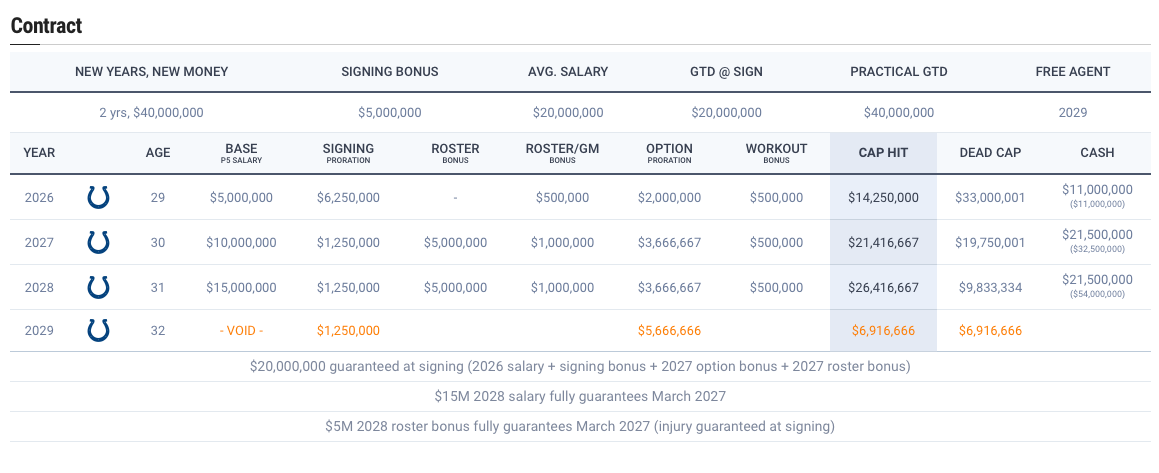
Jakobi Meyers actual extension (left) and Michael Pittman dummy extension (right)
Spotrac has Pittman's market value at 2 years, $60 million but that seems a tad high. Much like the Daniel Jones contract and the greater QB market, I feel like the WR market has peaked in recent seasons.
Teams are going to have to be smarter (and shrewder) about committing such hefty cap hits to players who aren't at the top of their position or ascending young talents; players who don't offer something truly unique or rare; players who aren't a nightmare to gameplan against.
Then again, "A bird in the hand is worth two in the bush." Or to put it another way:
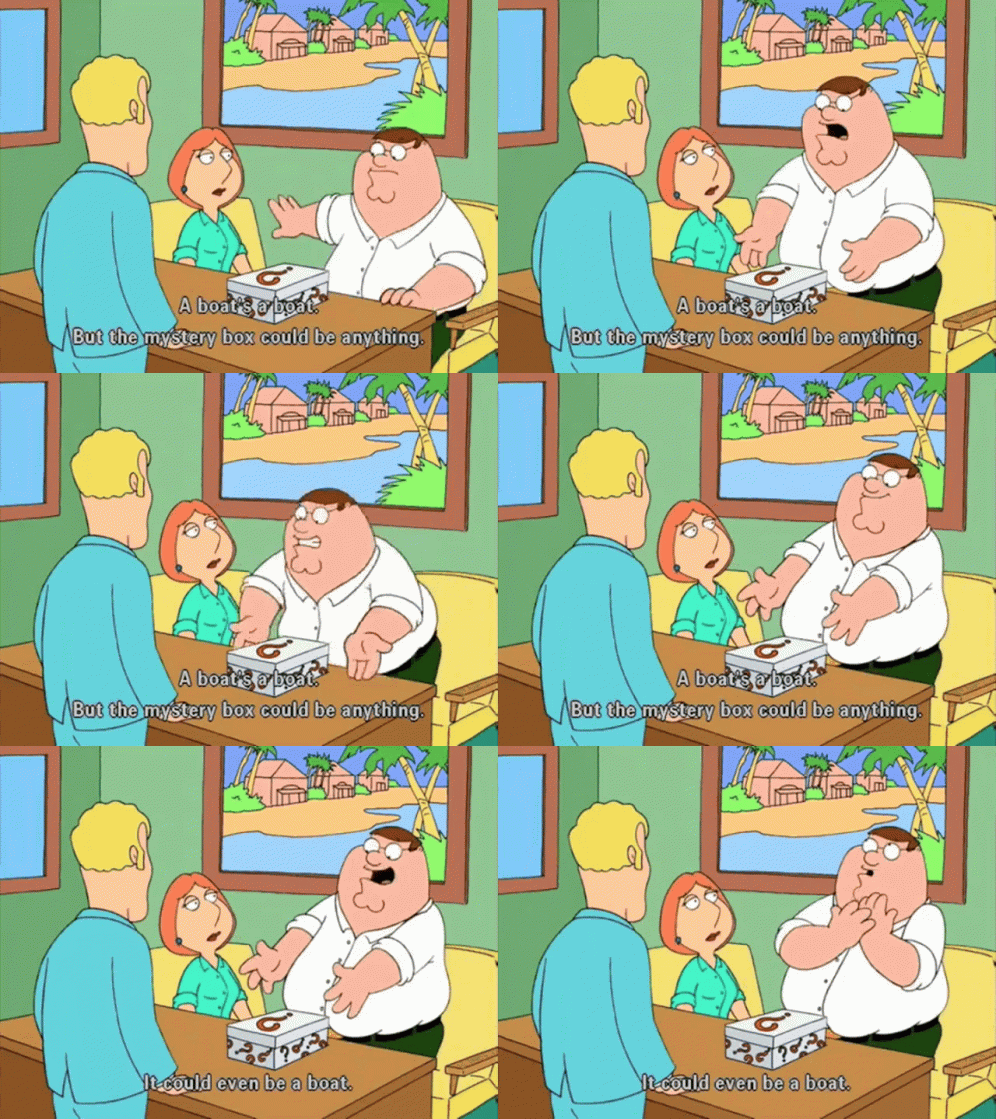
Is Michael Pittman still a boat? Was he ever a boat? Does Pittman offer the Bills or Colts more instant value — read: stability — than onboarding a rookie? Would Bills fans be excited about Pittman?
What if the Bills were able to get Pittman for their 2026 5th-round pick, similar to what the Commanders traded for Deebo Samuel?
Would Pittman take less money on a new deal? Here's what he had to say after signing an extension during the 2024 offseason:
“I don’t look at other guys' [deals] and kick myself. I don’t really care that much because … even if guys are getting more, I think what I’m getting is a decent amount of money.” —Pittman on signing his contract extension after being franchise-tagged during the 2024 offseason
While there's inherent risk in trading for a wide receiver who's knocking on the dreaded "age cliff" (30 years old), Pittman has been a reliable target who doesn't really miss time—he's tough as nails and routinely plays through anything—and Pittman fits the classic big-bodied receiver mold that the Bills have been searching for to move the chains, to be another option on 3rd downs and in the redzone.
However, he wouldn't solve the perceived problem — the main issue in the Buffalo receiving corps. The Bills need a receiver who can win on the outside AND down the field, who can threaten the defense with speed and separate from coverage on deeper routes.
For that, the Bills should look to the draft.
3b. Draft Makai Lemon
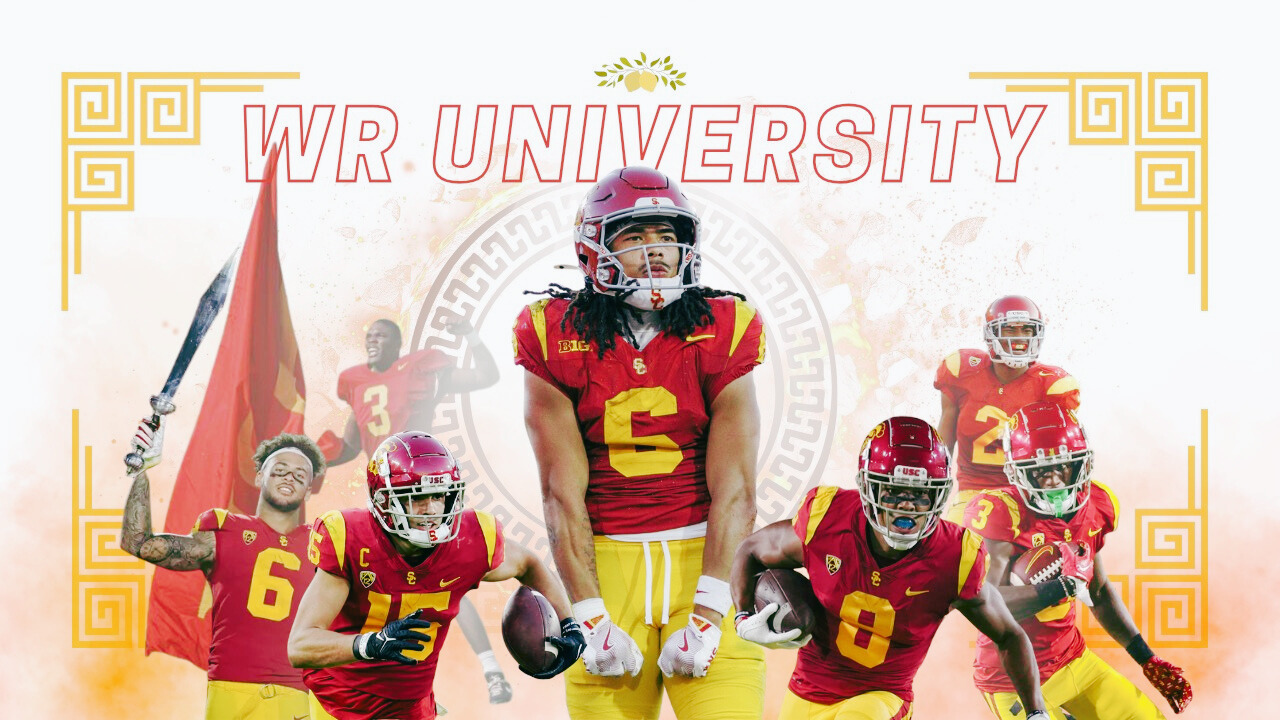
"[Carnell] Tate and [Makai] Lemon, for me, are war daddies who are ready to rock and roll and come in and make an immediate impact and play — there's just a warrior mentality to the way they both play, a toughness.
It has been kind of the secret ingredient if you look at the list of the top receivers, year in and year out, in the NFL: you will see different sizes, you will see different speeds. But almost to a man, if you go back through their reports you'll find toughness as a key part of who they are and what they are." —Daniel Jeremiah on the Move the Sticks podcast (12/30/25)
Just how good has Makai Lemon been these past few seasons? I had to know, so I went digging through the Sports Info Solutions database.
First, I looked at all USC wide receivers from 2016 to 2025 and had 93 different options to choose from. Then, I wanted to see how each of the Trojans performed on all of their targets in the following situations:
- Downfield targets (10+ yards past the line of scrimmage)
- Targets when their QB was blitzed
- Redzone targets
- Money downs (3rd & 4th down targets)
- 2-minute drill targets
That narrowed things down to five Trojans across 10 szns:
- Makai Lemon (2024-25)
- Jordan Addison (2022)
- Drake London (2020-21)
- Amon-Ra St. Brown (2018-20)
- Michael Pittman Jr. (2018-19)
Here's how they stacked up across situations:
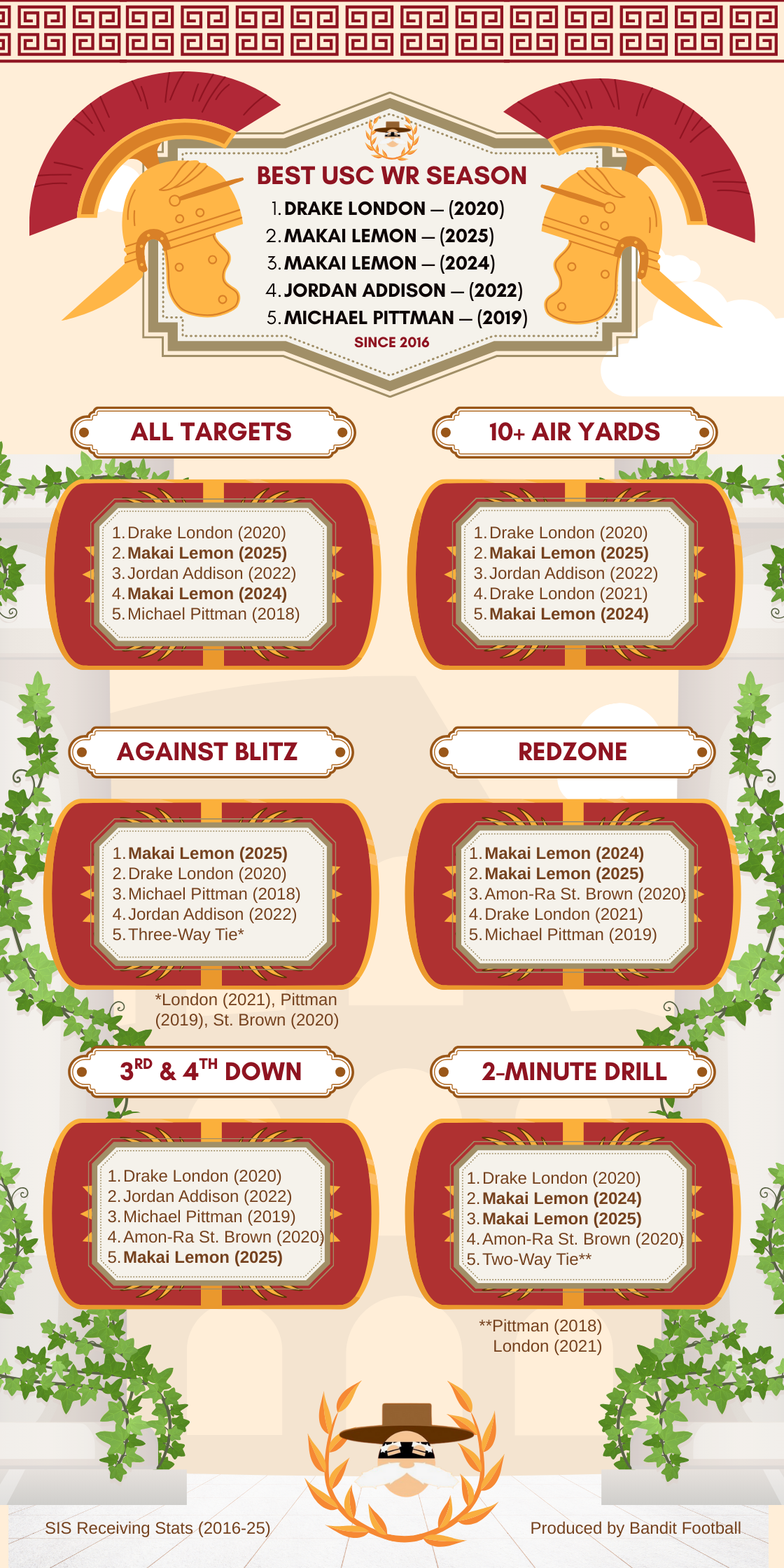
Top 5 Seasons
| Trojan | Season | Games | Routes Run | Targets |
|---|---|---|---|---|
| Drake London | 2020 | 6 | 245 | 48 |
| Makai Lemon | 2025 | 12 | 316 | 110 |
| Makai Lemon | 2024 | 12 | 232 | 72 |
| Jordan Addison | 2022 | 11 | 285 | 81 |
| Michael Pittman | 2019 | 13 | 500 | 139 |
To determine the overall ranking, I narrowed things down to the following nine stats in each of the situations, ranked them, then averaged their rankings together:
- Catchable Rate: Receptions divided by targets that were deemed catchable
- Drops Per Target: Situational drops divided by situational targets, for example: Drops against the blitz divided by targets against the blitz
- Bullseye Rate: Air yards divided by intended air yards, or the number of receiving yards made at the catch point divided by the potential yardage on all targets (including where there wasn't a catch)
- Tough Yards Per Reception: Any yards after the catch that were gained after contact
- Broken Tackles, Missed Tackles Forced (BTMF) Per Reception
- First Downs Gained Per Catchable Target
- Defensive Pass Interference Per Catchable Target
- Bullseye Plus-Minus: Average depth of target minus average depth of completion
- Boom Rate: Percentage of very sick plays (equivalent to adding 1 point on the scoreboard) minus the percentage of very disgusting plays (equivalent to losing 1 point on the scoreboard)
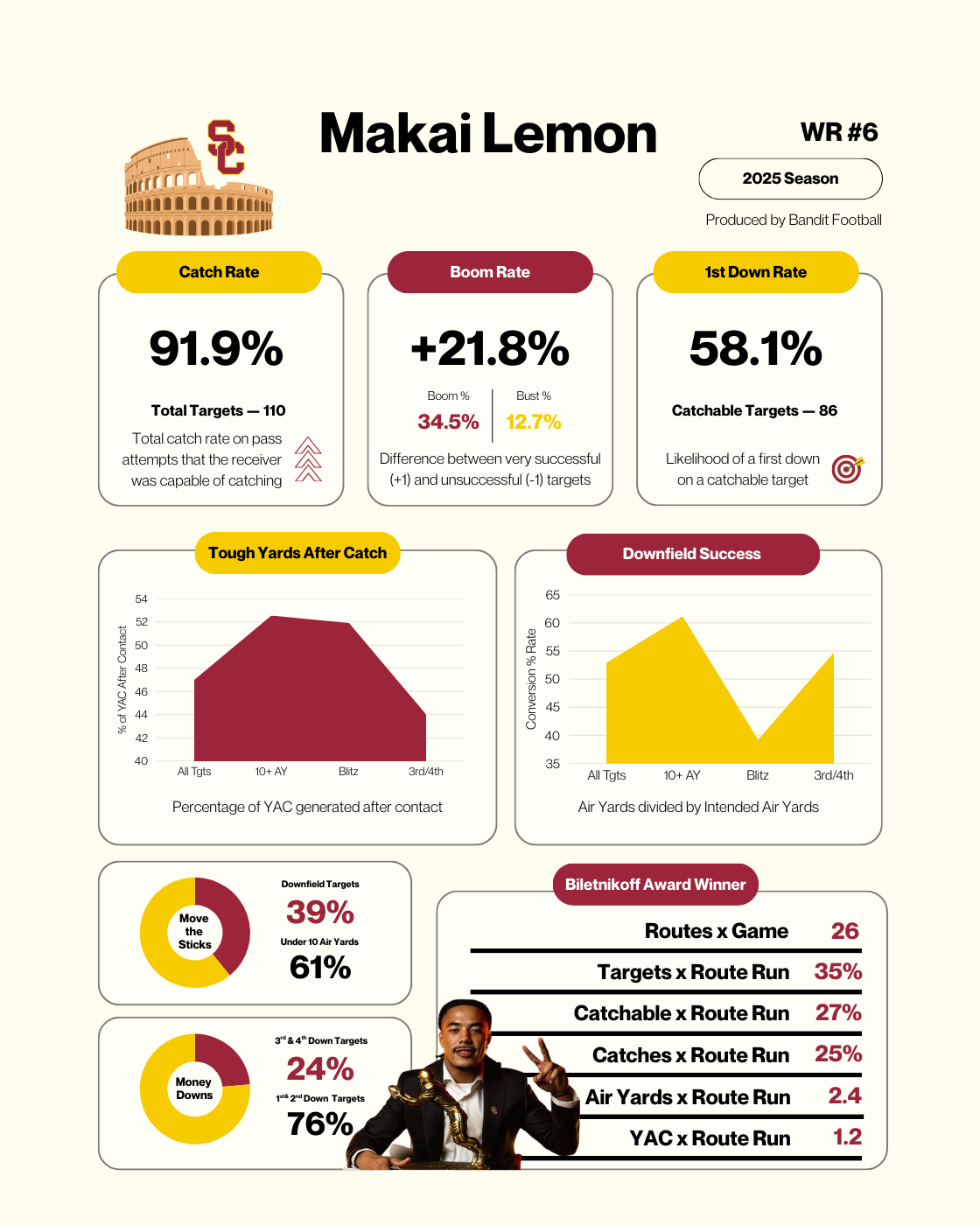
"An explosive, twitchy receiver with great acceleration, Lemon displays great body control and route nuance. He is a QB-friendly wideout who works back to the football, tracks it well in the air and catches basically anything in his orbit. In 182 targets over the last two seasons, Lemon was credited with only two drops."
"Of the three players with a realistic argument for WR1 (Lemon, Ohio State’s Carnell Tate and Arizona State’s Jordyn Tyson), Lemon (5-11, 195) is the smallest. He does not play small, though — he gets absolutely everything out of his body on every rep." —Nick Baumgardner in The Athletic
Therein lies the rub: Makai Lemon is under six feet tall and weighs less than two hundred pounds. When scouting for Sports Info Solutions last winter, we were given WR benchmarks of 6-foot flat and 195 lbs. with a 40-yd. dash time of 4.50 seconds. The Combine will be key in determining Lemon's draft stock as we look forward to the spring.
As I've written about in the past and yelled about to just about anyone who would listen: I don't give a shit about size concerns if a wide receiver demonstrates the ability to consistently get open and separate against top competition.
One way to try and gauge that without added film study is to look at some of the more nuanced stats focusing on a receiver's boundary reps rather than their opportunities from the slot and over the middle of the field.
Boundary Targets Per Game
| 2026 Prospect | School | Tgts/GM | Bullseye Rate | DPI Rate |
|---|---|---|---|---|
| Malachi Fields | N. Dame | 3.2 | 32% | 92% |
| Jordyn Tyson | ASU | 3.1 | 30% | 65% |
| Chris Brazzell | Tenn | 3.0 | 48% | 112% |
| Chris Bell | L'Ville | 2.9 | 56% | 83% |
| Elijah Sarratt | IU | 2.8 | 54% | 81% |
| Ja'Kobi Lane | USC | 2.8 | 49% | 87% |
| Denzel Boston | Wash | 2.7 | 44% | 100% |
| Carnell Tate | OSU | 2.5 | 47% | 79% |
| Deion Burks | OU | 2.4 | 44% | 86% |
| CJ Daniels | Miami | 2.1 | 44% | 79% |
| Makai Lemon | USC | 1.9 | 66% | 109% |
| KC Concepcion | A&M | 1.9 | 46% | 110% |
| Germie Bernard | Bama | 1.8 | 43% | 72% |
DPI rate was calculated by first adding the number of boundary catches to the number of DPI penalties that the wide receiver drew against coverage.
Then, that sum was divided by the number of catchable targets the wide receiver had seen along the boundary.
This allowed some WRs to score more than 100 percent, which means they actually caught some of those targets when defensive pass interference was called.
That means the catch itself was more valuable than the NCAA's 15-yard penalty, and therefore the penalty was declined.
To determine "Boundary Targets," I narrowed down the sample size to make sure they checked two specific boxes: 1) only include targets where the receiver was lined up wide at the snap (eliminating their slot targets) and 2) those targets must have been on the left or right side of the field—the boundary (eliminating the middle of the field).
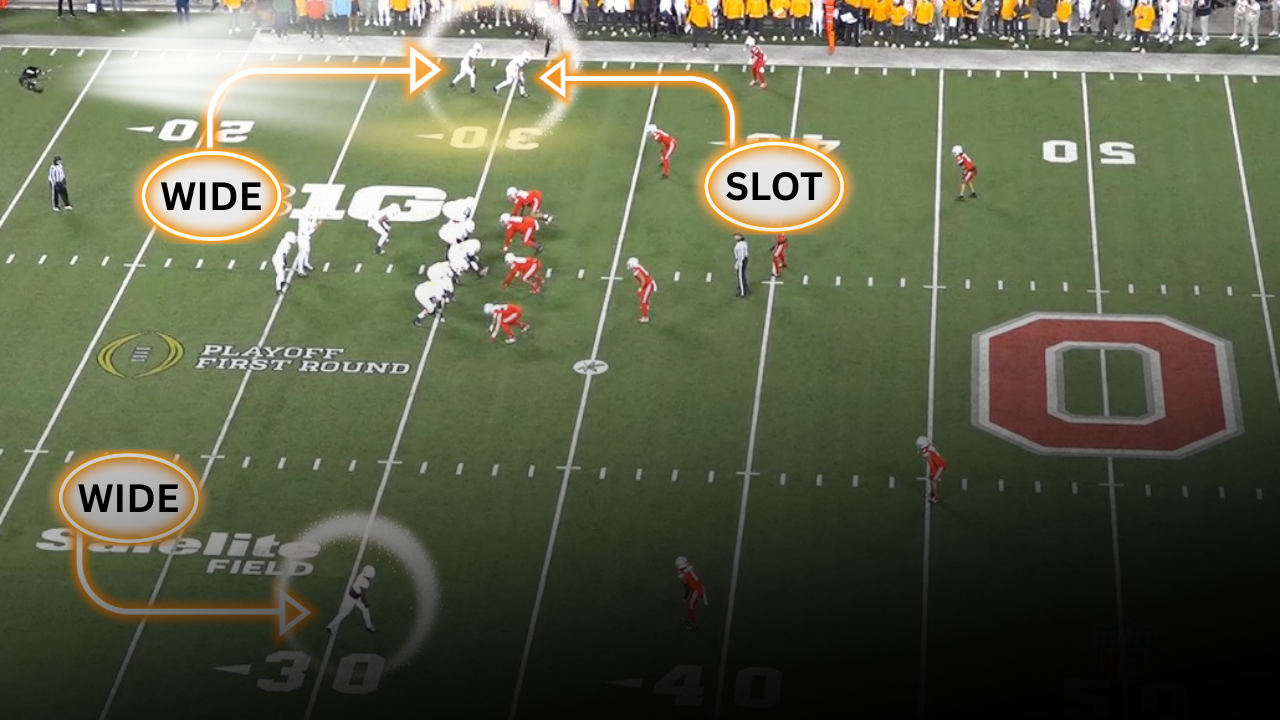
But then I got to thinking... about formations and how sometimes, even if two players are aligned out wide — like way, way out wide and away from the formation — that only one of the receivers, the WR who is furthest away from the formation will be marked "wide" by the charting (i.e. how the sausage is made; the data is collected), and any other wide receivers on that side would be marked in the "slot."
It's easier to explain with screenshots.
The same goes for extremely condensed sets. You might consider both wide receivers aligned in the slot, below, since they're both so tight to the formation.
However, this is how they'd be charted (at least by PFF).
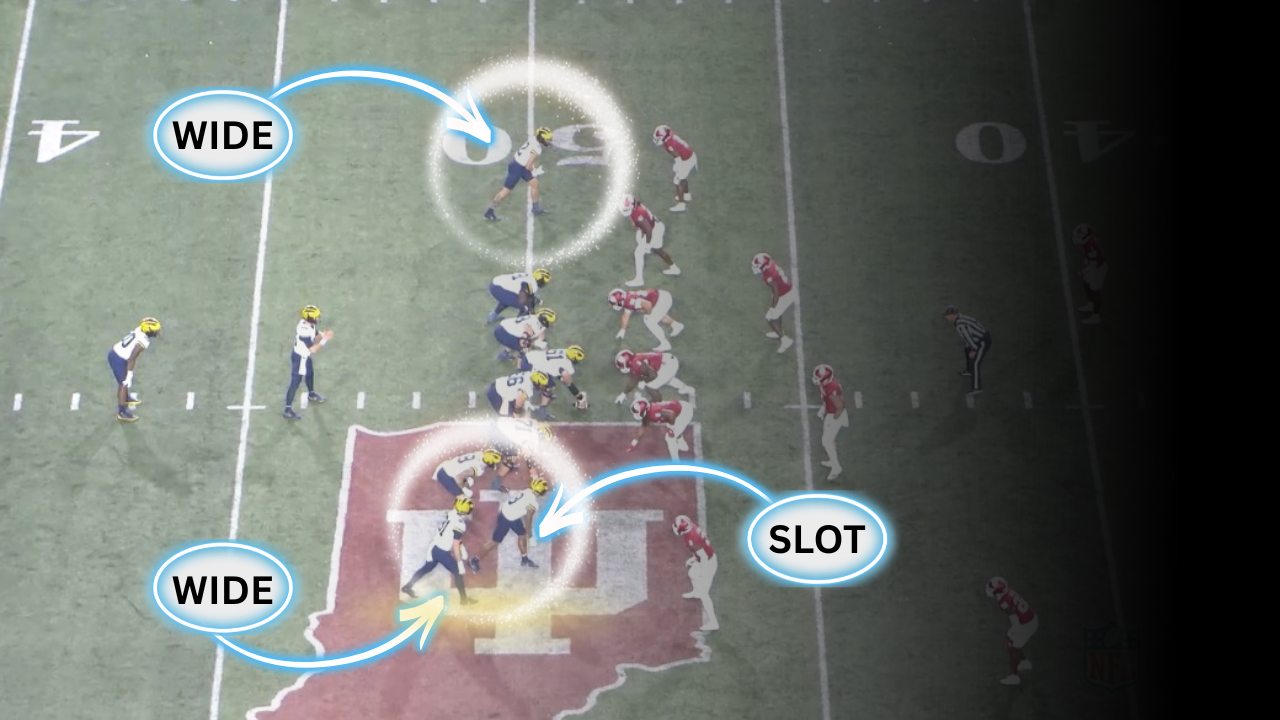
So, yeah: I figured I needed to some add further nuance to these "Boundary Targets" to get a truer idea of their stats.
To make matters worse, when I was checking my work, I realized each receiver in the sample didn't receive a Boundary Target in every game they played, so those numbers were potentially inflated and needed to be adjusted.
Finally, since this is about fixing the Bills WR problem with a downfield boundary threat, I wanted to adjust the stats to only include targets that were 10+ yards downfield.
With those adjustments in mind, here's the updated stats for the Top 5 WRs on PFF's Big Board.
True Boundary Targets Per Game
| 2026 Prospect | PFF Big Board | Adj. Tgts/GM | Bullseye Rate | DPI Rate |
|---|---|---|---|---|
| J. Tyson | #7 | 3.0 | 29% | 53% |
| C. Tate | #8 | 1.6 | 48% | 77% |
| M. Lemon | #11 | 1.3 | 59% | 117% |
| D. Boston | #20 | 2.5 | 39% | 94% |
| KC Concepcion | #26 | 1.4 | 41% | 100% |
PFF Big Board rank as of January 16, 2026
Stats created using SIS data
Would the Bills be willing to trade up to select a wide receiver in the 1st Round — and if so, just how far up the board would they need to go?
“I probably deserve criticism for trading up sometimes, I get that,” Beane said, “but if there is a guy I like and I’m confident, I want to go to bed Thursday night [after the 1st round knowing] that I got him." —Bills GM Brandon Beane, 2024
Cost of Trading Up
The Bills will likely need to trade up to get their WR of choice, with a pick in the 11-15 range probably being the sweet spot.
- 1.11 — Miami Dolphins
- 1.12 — Dallas Cowboys
- 1.13 — Los Angeles Rams
- 1.14 — Baltimore Ravens
- 1.15 — Tampa Bay Buccaneers
There are a few charts out there to help construct a trade up, with the Jimmy Johnson trade value chart being the most well-known. I'm going to use it as well as the Fitzgerald-Spielberger chart, which was developed with salary data from the 2011-15 NFL Drafts.
Both charts assign a numeric value to each draft pick, which I'll list below.
- 1.11 — (1,250 — JJ) or (1,785 — FS)
- 1.12 — (1,200) or (1,741)
- 1.13 — (1,150) or (1,700)
- 1.14 — (1,100) or (1,663)
- 1.15 — (1,050) or (1,628)
As of this writing, the Bills 1st Round pick will be valued anywhere from 590 to 700 in the Jimmy Johnson chart or 1,244 to 1,349 in the Fitzgerald-Spielberger chart.
Before looking any of this up, I used the PFF Mock Draft Simulator and found that the most commonly accepted trade-up package was sending the Bills' 2026 1st- & 2nd-round picks plus their 2027 3rd-rounder to move into the Top 15.
Here's how the trade would look using the value charts:
- Jimmy Johnson (aiming for 1,050 to 1,250 in value)
- 860 to 1,020 in 2026 value
- plus ~116 to ~185 in 2027
- 860 to 1,020 in 2026 value
- Came up just short with 976 to 1,205 in overall trade value.
- Fitzgerald-Spielberger (aiming for 1,628 to 1,785 in value)
- 2,136 to 2,291 in 2026 value
- plus ~687 to ~773 in 2027
- 2,136 to 2,291 in 2026 value
- Easily cleared the bar with 2,823 to 3,064 in overall trade value.
Quite the spread between the two.
Would the teams in that range even accept a trade?
1.11 — The Dolphins recently hired a new general manager and will have a new head coach, not to mention the fact they play the Bills twice a year.
1.12 & 1.13 — The Cowboys and Rams have two selections in the first round and may look to move up in the draft, not down, by the time April rolls around.
1.14 — The Ravens are a perennial playoff rival that will have a new head coach.
1.15 — By the time the Bucs are on the board, the Top 3 wide receivers could be long gone.
It's going to be tough for the Bills to get a top WR prospect in the draft. That being said: I'm of the belief that it's fairly easy to justify the cost of trading up if it leads to a more dynamic offense capable of hanging 40 points in a brand new stadium.
"[Makai] Lemon is from the tree, right. He's from the Amon-Ra St. Brown, the JSN — he's kind of in that lineage of wide receiver. My thing that I wrote about him was just deploy him like the Patriots deployed Julian Edelman and watch this guy catch 100+ balls every year.
That's what he is. He's a tough, strong slot receiver who's not afraid to work in the middle of the field, who's excellent after the catch, who's got strong, strong hands to attack the ball and win in traffic. He is a good player, man" — Daniel Jeremiah on the Move the Sticks podcast (12/30/25)
While Makai Lemon would be my pick of the litter in this year's draft, the Bills may view his skill set as "too duplicative" of Khalil Shakir.
To that I would say: double down on your strengths so you're better prepared to do what you want when injuries strike.
And I would also add through gritted teeth: Shakir and Lemon are both capable of winning on the boundary — capable of dusting defensive backs and racking up yards downfield.
Brandon Beane has tended to swing for the fences with his top pick, however, and Lemon is more of a double off the wall than a dinger.
| Draft | Pick | Player | Thinking |
|---|---|---|---|
| 2017 | 1.27 | Tre' White | Double (1) |
| 2018 | 1.07 | Josh Allen | Dinger (1) |
| 2018 | 1.16 | Tremaine Edmunds | Dinger (2) |
| 2019 | 1.09 | Ed Oliver | Double (2) |
| 2020 | Trade | Stefon Diggs | Dinger (3) |
| 2021 | 1.30 | Greg Rousseau | Double (3) |
| 2022 | 1.23 | Kaiir Elam | Double (4) |
| 2023 | 1.25 | Dalton Kincaid | Dinger (4) |
| 2024 | 2.01 | Keon Coleman | Dinger (5) |
| 2025 | 1.30 | Maxwell Hairston | Dinger (6) |
By my count, that's 6-to-4 with dingers over doubles (or strikeouts) versus simply getting a runner in scoring position.
Perhaps there's another option on the trade market. Maybe a different guy in the AFC South. A home-run threat who was bandied about at the trade deadline. One who was coached by Chad Hall and had the third most receiving yards in the friggin' league as a rookie.
3c. Trade for Brian Thomas

If the Jaguars are going to trade Brian Thomas Jr., then Travis Hunter would need to play a fairly important role on offense in 2026 and beyond.
"We still expect him to play on both sides of the ball [in 2026]."
"Obviously, you can take a peek at the expiring contracts on our roster and which side of the ball has more. At this point, walking into the offseason, corner is a position where we have a few guys on expiring contracts. By default, you can expect there to be a higher emphasis on [Hunter's] placement."—Jaguars GM James Gladsone talking about Travis Hunter's 2026 role on offense and defense on January 14, 2026
As Sports Illustrated's John Shipley notes in the article, Hunter played exactly twice as many snaps on offense as he did on defense during his rookie season. It's reasonable to expect that number to be closer to 50-50 or even flip to a majority of defensive snaps.
Back before the trade deadline, around Halloween, Jaguars coach Liam Coen said the team did not intend to move Brian Thomas Jr. following reports that the struggling second-year receiver could be traded.
That same afternoon, on October 27, ESPN's Michael DiRocco said Travis Hunter could start "getting the WR1 treatment from the Jaguars in the season's second half."
Things continued to snowball during a whirlwind week:
- Travis Hunter lands on injured reserve with a torn LCL on October 30.
- On November 2, Brian Thomas caught 3-of-5 targets for 55 yards against the Raiders but left the game with an ankle injury and did not return.
- The Jaguars traded their 2026 4th- & 6th-round picks to the Raiders for Jakobi Meyers on November 4.
- That same afternoon, Adam Schefter reported BTJ was dealing with a "low-grade" high-ankle sprain.
- Brian Thomas Jr. missed the team's next three games.
During BTJ's absence, Jakobi Meyers, Brenton Strange, and Parker Washington became the engine of the Jaguars passing attack.
Following a Week 10 loss in Houston against backup QB Davis Mills, the Jaguars rattled off eight consecutive wins to finish the regular season with a 13-4 record atop the AFC South.
Here's how the passing game looked when BTJ returned from injury:
Jaguars Passing Game (Weeks 13-19)
| Player | Tgts/GM | Boundary Shots/GM | Bullseye Rate | Tough Yds |
|---|---|---|---|---|
| J. Meyers | 7.1 | 1.3 | 52% | 24% |
| P. Washington | 7.8 | 1.3 | 58% | 66% |
| B. Strange | 5.1 | 0.4 | 48% | 41% |
| B. Thomas Jr. | 4.7 | 2.6 | 43% | 37% |
| T. Etienne | 2.9 | 0.1 | 14% | 45% |
More than half of BTJ's targets were downfield boundary shots. He doubled-up Jakobi Meyers and Parker Washington as the clear downfield threat in the offense while also clearing out space for the two higher-volume, middle-of-the-field wideouts in the Jaguars' West Coast-centric offense.
What about when Travis Hunter was on the field earlier in the season?
Jaguars Passing Game (Weeks 1-7)
| Player | Tgts/GM | Boundary Shots/GM | Bullseye Rate | Tough Yds |
|---|---|---|---|---|
| B. Thomas Jr. | 7.9 | 2.6 | 38% | 19% |
| T. Hunter | 6.3 | 1.1 | 41% | 61% |
| P. Washington | 5.0 | 1.3 | 25% | 75% |
| D. Brown | 4.5 | 1.7 | 76% | 31% |
| B. Strange | 4.8 | 0.7 | 47% | 67% |
While Brian Thomas saw more targets overall during the early part of the season, his boundary shots per game remained the same throughout the year.
In terms of his connection with Trevor Lawrence, the latter seven games were about 5% better than the first seven.
Overall, though, the connection between Brian Thomas Jr. and Trevor Lawrence could be described as spotty at best. Would BTJ be better with a different QB?
Here's how things looked with Mac Jones under center.
Splits with Mac Jones
| Quarterback | Games | Boundary Shots/GM | Bullseye Rate | 1st Downs/GM |
|---|---|---|---|---|
| T. Lawrence | 24.5* | 2.2 | 45% | 2.4 |
| M. Jones | 7.5* | 2.9 | 41% | 3.7 |
*Trevor Lawrence started Week 12 in 2024 but was injured with 4:20 remaining in the 2nd quarter and replaced by Mac Jones. BTJ didn't see a target from Jones until the 3rd quarter.
Overall, Mac Jones was able to get the ball to the boundary at a higher rate than Trevor Lawrence but the Bullseye Rate needed to be explored.
In the first nine games of the 2024 season, BTJ had a whopping 668 intended air yards. He hauled in 368 of them for a Bullseye Rate of 55% and 5 touchdowns. At the time, that was good for #12 in the league in air yards and #20 in intended air yards.
Is that something the Jaguars want to trade away? I mean, they've seen it happen. We all saw it happen. That's why the Bills would come calling.
Could Travis Hunter fill the boundary role?
Travis Hunter's College Splits
| Season | Tgts/GM | Boundary Shots/GM | Bullseye Rate | Tough Yds |
|---|---|---|---|---|
| 2023 | 8.6 | 1.7 | 49% | 38% |
| 2024 | 9.6 | 2.2 | 58% | 55% |
Although it's tough to see him completely filling the boundary role, there's certainly an argument to be made for having your two-way phenom primarily run wind sprints rather than take hits on screen passes and other short-area YACko-tunities.
There's a chance. James Gladstone has been the Jaguars GM for less than a year but he's already executed 10 trades.
It should be noted — and it must be noted — that he had that power, the power to trade, taken away from him on November 4 at the NFL trade deadline.
He has only been able to trade for 256 days in his whole life as Jaguars general manager.
If you exclude weekends and federal holidays that number drops to 177!
| Hired | Trades | Trade Rate | Adj. Rate | Draft Day Trades |
|---|---|---|---|---|
| 2/21/25 | 10 | Every 25.6 Days | 17.7 Days | 3 |
Here's a look at the Jaguars 2026 Draft capital
- Round 2, Pick 56
- Round 3, Pick 81 (via Detroit)
- Round 3, Pick 88
- Round 3, Pick 100 (via Detroit, comp pick)
- Round 5, Pick 162
- Round 5, Pick 164 (via San Francisco)
- Round 6, Pick 196 (via Atlanta from Philadelphia)
- Round 7, Pick 233
- Round 7, Pick 245 (via Los Angeles)
Sure looks like the Jaguars could use a 1st-round pick. Not necessarily to draft a guy in April, but to gift themselves all that possibility, to dream up all the potential trades another 1st-rounder would open up for them.
There's 43 days between the start of free agency (March 11) and Round 1 of the draft (April 23). That's plenty of time for the Jags to dream up a masterpiece in Year 2 of the Gladstone-Coen partnership.
If the Bills are going to strike a deal for Brian Thomas Jr., they should try to do it the second the league year begins on March 11 at 4:00:00 PM New York Time. Don't even wait a minute.
All Eyes on Indianapolis
Whatever the Bills end up doing to address their WR problems this offseason, things will become clearer when the league descends on Indianapolis for the Scouting Combine from February 27 to March 2.
They'll have the chance to interview Makai Lemon and Carnell Tate and Jordyn Tyson if they so choose. Maybe even Germie Bernard.
Perhaps they'll send somebody out to Michael Pittman's farm to let him known Western New York isn't all that different from rural Indiana. We've got plenty farmland around the way.
By early March, the wounds of the Jaguars playoff defeat will be a faint memory as the potential at Lucas Oil Stadium fills the suites with nothing but hope. The Colts are without their 1st round pick in 2026 and 2027. They could use all the draft capital they can get — even if it's just another Day 3 pick.
Whatever happens, happens. But if the Bills draft another receiver who can't separate I'll lose my gd mind.